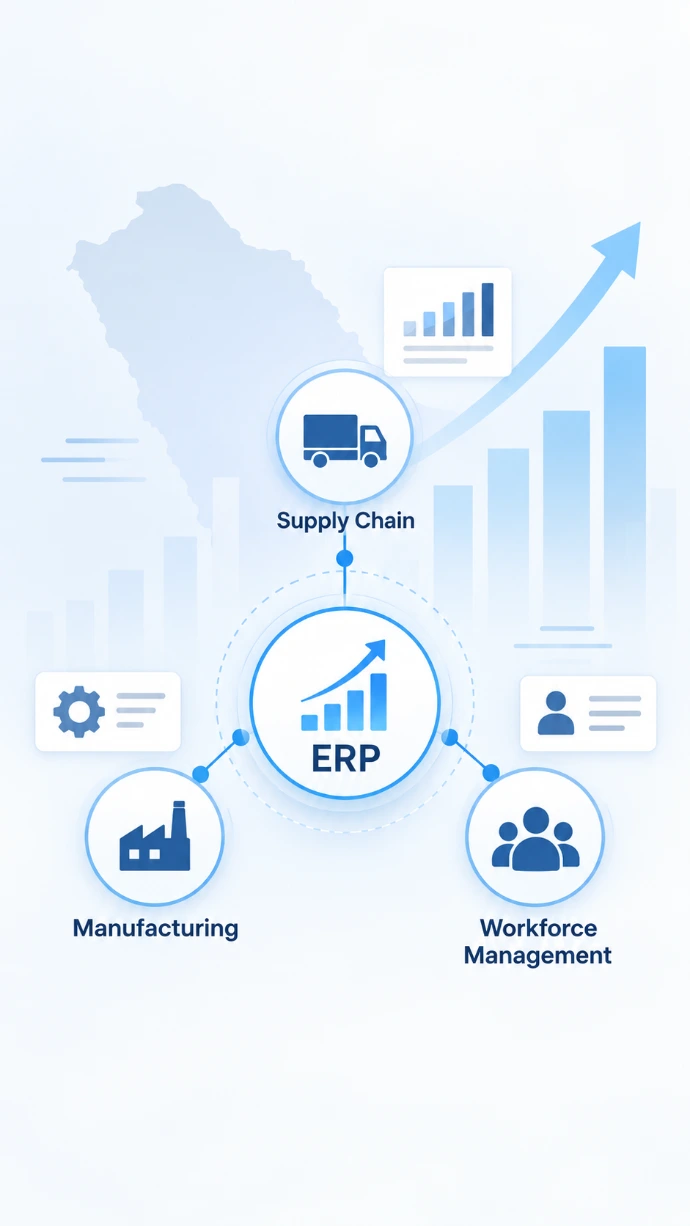
Why Manufacturing ERP Matters in 2026
A practical look at how connected ERP systems help factories in Egypt and Saudi Arabia control costs, improve planning, and gain better operational visibility.
Manufacturers in Egypt and Saudi Arabia are working in a market where costs change quickly, delivery expectations are rising, and competition is becoming stronger. The value of ERP is not simply replacing paperwork with software. It is creating a clearer view of the factory so managers can identify problems earlier and make decisions based on current data.
Many factories still depend on spreadsheets, paper records, and separate systems for purchasing, inventory, production, sales, and accounting. This makes it difficult to calculate reliable product costs, plan production accurately, or understand why a profitable order on paper produced a lower margin in reality.
A manufacturing ERP systemconnects these activities in one place. It gives production, warehouse, purchasing, quality, maintenance, sales, and finance teams access to the same information.
1. Manufacturing ERP for Production Cost Control
Estimated costs are useful when preparing quotations and budgets, but they do not always reflect what happens during production.
Raw material prices may change, a batch may require extra labor, or scrap and rework may increase the final cost. When purchasing, production, and accounting records are disconnected, these changes can remain hidden until the end of the month.
A properly configured manufacturing ERP solution can collect materials, labor, machine time, subcontracting, scrap, rework, and allocated overhead.
This allows managers to compare planned and actual costs for each production order and investigate major variances.
Connecting Purchasing with the Bill of Materials
The Bill of Materials, or BoM, defines the materials and components required to manufacture a product.
When supplier prices change, the costing team needs to understand how the change affects finished products. By connecting purchasing, inventory values, and the BoM, the ERP system can update cost information as new transactions are recorded.
For factories using multi-level BoMs, the system can also calculate the components required for subassemblies and finished goods. This is useful in machinery, automotive components, food processing, chemicals, and other industries with several production stages.
Revision control is equally important. When a product design changes, the system should clearly identify which BoM version applies to each production order.
ERP provides the structure for reliable costing, but the result still depends on accurate data. Material consumption, labor time, scrap, machine usage, and overhead allocation must be recorded consistently.
2. Manufacturing Inventory Management and Material Availability
Production cannot run smoothly when the inventory shown in the system is different from the stock physically available.
A warehouse record may show that a raw material is available, while employees cannot locate it. Materials may also have expired, been damaged, or been consumed without being recorded. These differences can lead to delayed work orders, emergency purchasing, excess stock, and missed delivery dates.
An integrated ERP platform can reserve materials for confirmed production orders and track their movement from the warehouse to work in progress and finished goods.
When projected stock falls below an agreed level, the system can alert purchasing or create a replenishment suggestion. A useful rule should consider confirmed demand, reserved quantities, open purchase orders, supplier lead times, safety stock, and expected customer orders.
Lot, Serial, FIFO, and FEFO Tracking
Factories handling products with batch, serial, or expiration requirements need detailed traceability.
The system can track materials from receipt through production and final delivery. Businesses that work with expiration dates may use FEFO, in which the item with the earliest expiration date is issued first. Other factories may use FIFO or another inventory method based on their policies.
The physical warehouse process must match the rules configured in the system. Software cannot maintain accurate inventory if movements are not recorded correctly.

3. Production Planning and Shop-Floor Visibility
Factory managers should not need to wait for weekly reports to discover that a machine stopped, a production order was delayed, or a batch generated excessive scrap.
Employees can record production activity through barcode scanners, tablets, work-center terminals, or connected equipment. They may report completed quantities, materials consumed, labor hours, scrap, downtime, and quality results.
This gives managers a more current view of the shop floor and helps answer practical questions: Which orders are running? Which operation is delayed? Are materials missing? Which batches are waiting for inspection?
Production Planning and Work-Center Scheduling
A realistic production schedule must consider the factory’s actual capacity.
Before assigning work, planners need to review machine availability, employee shifts, material availability, setup time, maintenance schedules, and order priorities.
Visual tools, such as Gantt-style schedules and work-order boards, make these limits easier to understand. If a machine becomes unavailable or a supplier delivery is delayed, planners can see the effect on other work orders and adjust the schedule.
4. Quality Control and Manufacturing Traceability
Quality checks are more effective when they are included inside the production workflow rather than treated as a separate activity at the end.
An ERP system can require inspections during raw material receipt, production operations, transfers between work centers, final inspection, and release of finished goods.
If a batch fails an inspection, the affected quantity can be placed on hold until the quality team decides whether it should be reworked, returned, scrapped, or accepted under an approved deviation.
Lot and serial tracking also support faster investigations. If a customer reports a defect, the company can identify the production order, supplier batch, materials used, inspection records, and finished products delivered.
This makes corrective action more focused and can prevent unnecessary recalls.
5. Preventive Maintenance for Manufacturing Operations
Unexpected equipment failure can disrupt an entire production schedule.
A maintenance module allows the factory to plan routine work based on dates, operating hours, production cycles, or manufacturer recommendations. It can also record breakdowns, repair time, spare parts, recurring faults, maintenance costs, and downtime.
Over time, this history helps managers identify equipment that is creating repeated delays or becoming expensive to maintain.
Preventive maintenance is based on planned intervals or usage. Predictive maintenance requires additional information. When the ERP environment is connected to sensors or condition-monitoring tools, data such as temperature, vibration, pressure, or energy consumption may help identify unusual machine behavior before a breakdown occurs.

6. ERP Compliance for Egypt and Saudi Arabia
Manufacturers in Egypt and Saudi Arabia also need their commercial and accounting systems to support local electronic invoicing requirements.
In Saudi Arabia, businesses included in the relevant ZATCA Phase 2 rollout waves must integrate their invoicing solutions with the FATOORA platform and issue invoices in the required format.
In Egypt, businesses subject to electronic invoicing requirements need to issue and submit applicable B2B invoices through the Egyptian Tax Authority’s system. Businesses with relevant consumer transactions may also need to support electronic receipts.
An ERP solution can generate invoice information from approved sales and delivery transactions, reducing repeated entry and improving consistency between operational and financial records.
Compliance still depends on correct registration, tax settings, customer and product information, integration testing, and ongoing updates.
7. Why Choose NTS for Manufacturing ERP Implementation?
Selecting the software is only one part of a successful ERP project.
The implementation partner must understand how the factory operates, including purchasing, material movement, production planning, costing, quality, maintenance, sales, and accounting.
A factory should not simply transfer every spreadsheet and approval step into the new system. Before configuration begins, the implementation team should review workflows, identify duplicated activities, and agree on departmental responsibilities.
A structured implementation normally includes process review, system configuration, data migration, integration, user testing, employee training, and post-launch support.
NTS provides localized Odoo ERP implementation services for businesses in Egypt and Saudi Arabia. Working with a regional partner can help manufacturers address local tax requirements, bilingual user needs, regional practices, and on-site operational challenges.
The best implementation is not the one with the largest number of features. It is the one that reflects the company’s real production process and gives employees a system they can use consistently.
Manufacturing ERP Frequently Asked Questions
Common questions about Manufacturing ERP brokerage companies.
Can ERP calculate the exact cost of every production batch?
ERP can calculate a reliable batch cost when materials, labor, machine time, scrap, subcontracting expenses, and overhead are recorded correctly. The result depends on data quality and the company’s costing rules.
Can the system track work in progress?
Yes. The system can track quantities as they move from raw materials to work in progress and finished goods, while showing the work center responsible for each stage.
Can ERP help prevent material shortages?
It can reserve materials, calculate projected demand, and alert purchasing teams when stock is expected to fall below the required level. Accurate inventory records and realistic supplier lead times are still essential.
Does manufacturing ERP support ZATCA and Egyptian electronic invoicing?
An ERP solution can be configured and integrated to support the relevant requirements. The scope depends on the company’s activities, obligations, integration method, and current technical rules.
Ready to Improve Your Factory Operations?
Discover how NTS Manufacturing ERP can connect production, inventory, costing, quality, maintenance, and planning in one integrated system.